Flat, supported transfer
Close-coupled belts and suitable surface grip help prevent leading edges dipping into gaps or packs rotating as they enter the weigh conveyor.
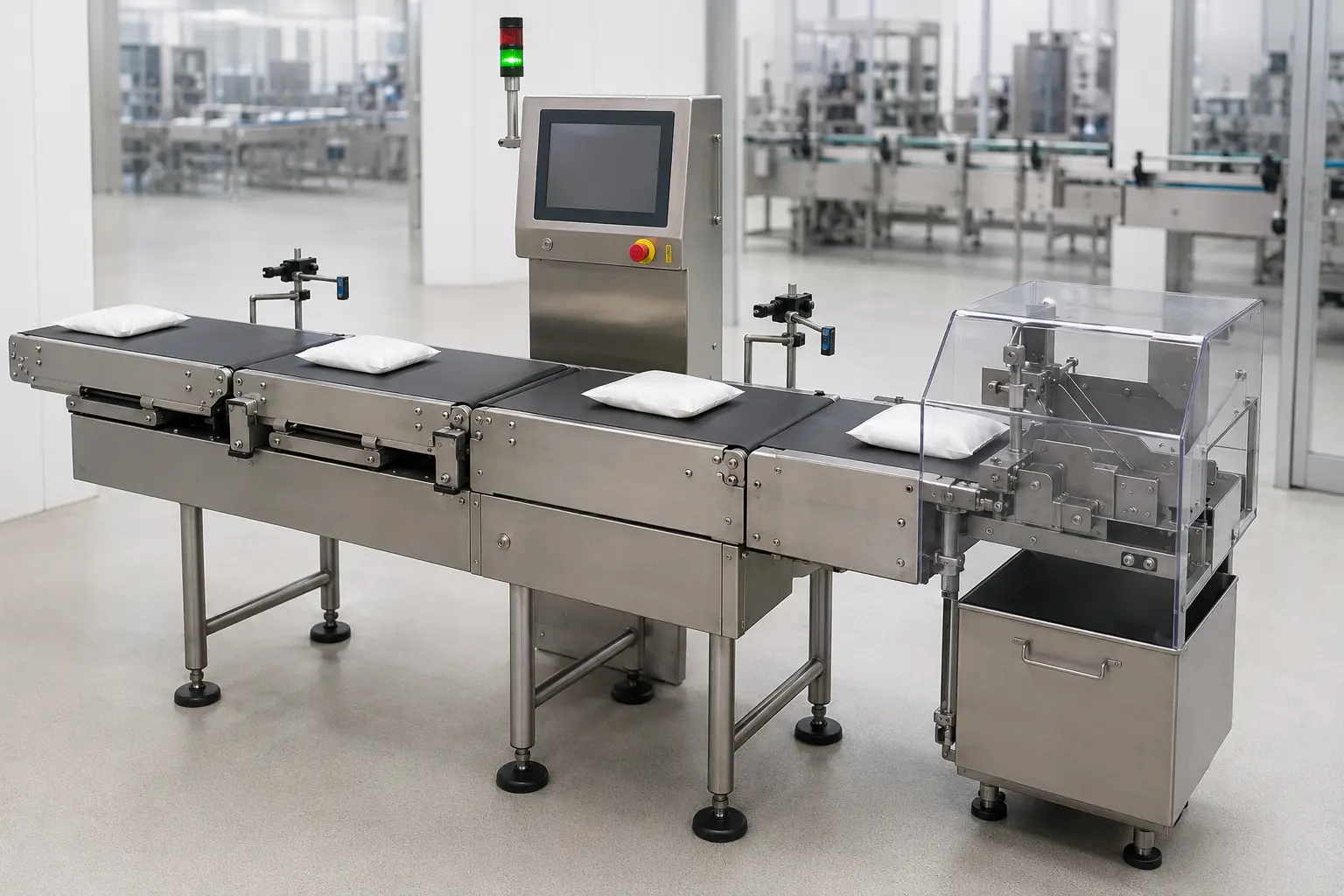
Flexible packs can curl, bounce, overlap and change shape as they move. We configure belt speed, transfer geometry, product spacing and rejection around the real pouch or sachet so weight results remain repeatable at production speed.
Flexible packs must be flattened, separated and transferred without curl, bounce or overlap obscuring the dynamic weight result.
Close-coupled belts and suitable surface grip help prevent leading edges dipping into gaps or packs rotating as they enter the weigh conveyor.
Acceleration belts, metering or upstream coordination can create the clear pitch required for one-pack-at-a-time measurement.
Air blast, drop-flap and compact diverter options are assessed against pack mass, seal integrity, speed and the required collection method.
Weight trends and fault signals can be exchanged with compatible VFFS, HFFS or pouch-filling equipment to support line control.
A pouch line is most stable when product pitch is established before the weigh conveyor and both machines share run, ready and fault states. Where filling feedback is appropriate, filtered trend data can help correct gradual drift without chasing the normal pack-to-pack variation of powders, granules or liquids.
Weight inspection can be coordinated with seal, label, code or visible-pack checks when presentation remains suitable for both weighing and image capture.
Discuss integrated inspectionThese answers cover light-pack performance, overlap, format changes, multi-lane layouts and feedback to compatible filling equipment.
Yes, within the performance envelope of the selected system. Drafts, vibration, belt condition and product pitch become increasingly important as target weight falls.
Spacing belts or upstream timing changes may separate packs, but the best method depends on how products leave the bagger or sealer. A line video is useful for early assessment.
Usually, if the formats remain inside the conveyor, weight and reject envelope. Each format can use a dedicated recipe.
Yes, provided the filler supports an appropriate correction input and the process is suitable for averaged feedback.

Turn downstream weight measurements into controlled adjustments at the filler. Rather than reacting to one pack, feedback logic evaluates a defined sample and applies bounded corrections when a genuine process trend is established.
Explore system
Make weight inspection information useful beyond the machine HMI. From simple batch reports to line-level data exchange, we define the records, identifiers, retention and interfaces your production and quality teams actually need.
Explore system
Inspect correctly presented packs at the agreed production rate, classify them against defined limits and remove non-conforming items with an application-matched reject system. We configure the weighing conveyor, controls, reject method and data outputs as one practical system.
Explore systemUse the next guide that matches the engineering or quality question behind your project.
Share pack details, target weights, line speed and any inspection or data requirements.